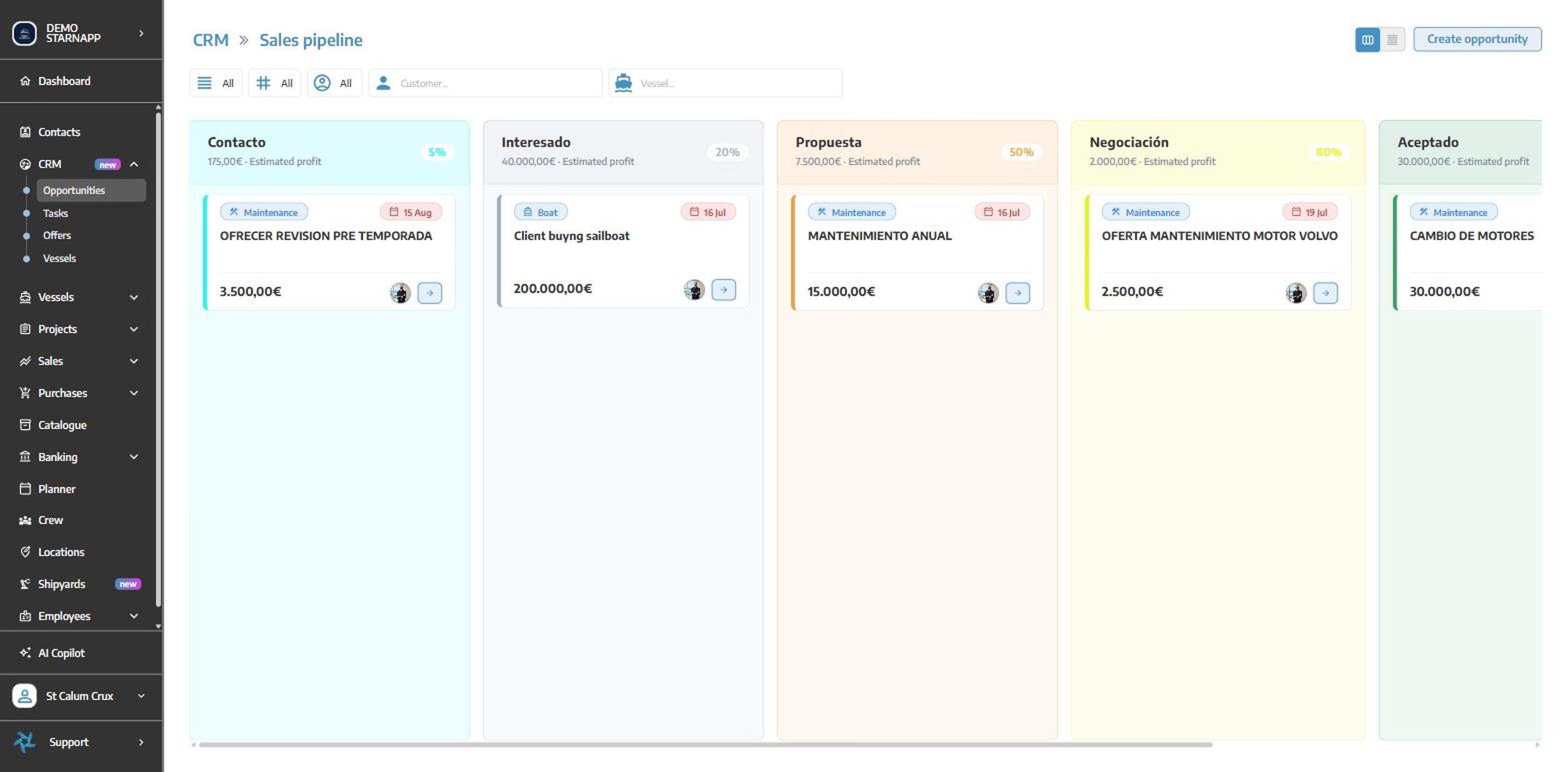
Customise your pipeline with the stages and opportunity types you need. Leads, tasks and your sales team in one place, inside the same platform as your workshop — and create catalogues of new and used boats to share with prospects.
Email, spreadsheets, sticky notes, phone calls and a separate quotes folder — with the boat's history somewhere else entirely.
Quotes, conversations, boat status and service history live together rather than in disconnected tools — so a technician arrives already knowing what was promised.

Bring sales, service and every customer promise into the same system as the boat, its maintenance history and its parts. One platform. One source of truth.
A customer moves from first enquiry to ongoing service without their history — or a promise — getting lost.
Yes. Customise your pipeline: build the stages you need and define the opportunity types your business uses. Each opportunity carries a win probability and an estimated profit, so you can see what the pipeline is actually worth.
Yes. A deal can be attached to both the customer and the vessel it concerns, so the quote sits alongside that boat's specs and its whole service history rather than in a separate system.
Yes. The CRM holds opportunities, tasks and offers together, which is what keeps long marine sales cycles from going quiet because one person forgot to chase.
It flows into operations. The accepted opportunity becomes work your team plans and delivers against the same customer and vessel record, so the technician has the full context.
Granular roles decide who sees what. Commercial and technical teams work from the same real-time information without everyone having the same permissions.
That is the point of it being built in. The reason marine businesses run five tools is that generic CRMs do not know what a vessel is — here the pipeline, the boat and the job are one system.
Twenty minutes, your boats, your jobs. No slides.